MaxUp CRM
What happens to an enquiry between the portal and the booking.
This is the longer version. If you only have a minute, the short one is that a buyer who enquires at 9:40 on a Sunday night gets a real reply before 9:41, from your own WhatsApp number, and somebody’s name is already on the lead by the time anybody wakes up.
The sequence
Seven steps, and nobody is awake for any of them.
- 1 · It arrives. The portal posts it to a URL that belongs to your workspace. The raw delivery is written down before anything tries to read it, so a payload we have never seen is a thing to fix rather than a lead that vanished.
- 2 · It is matched to a person. Deduplicated on the phone number, so a buyer who enquired about Tower B last month is the same human being, not a second row.
- 3 · It gets an owner. By your rules — project, source, shift, round-robin — evaluated in the same request, so the answer is known before the page finishes loading. A lead with no owner and no claim queue is treated as an accident and swept up.
- 4 · The buyer is answered. A WhatsApp message from your own verified number, inside seconds.
- 5 · It is attributed. Source, campaign and whether a channel partner registered it — recorded at the moment of creation, because this is the question you will ask in March about a lead that arrived in November.
- 6 · The clock starts. A response target that pauses when your office is shut, and escalates to a manager and then to somebody else when it is not met.
- 7 · In the morning, your team opens a list sorted by what is worth ringing, not by what arrived last.
Every lead, one way in
Four doors, one room behind them.
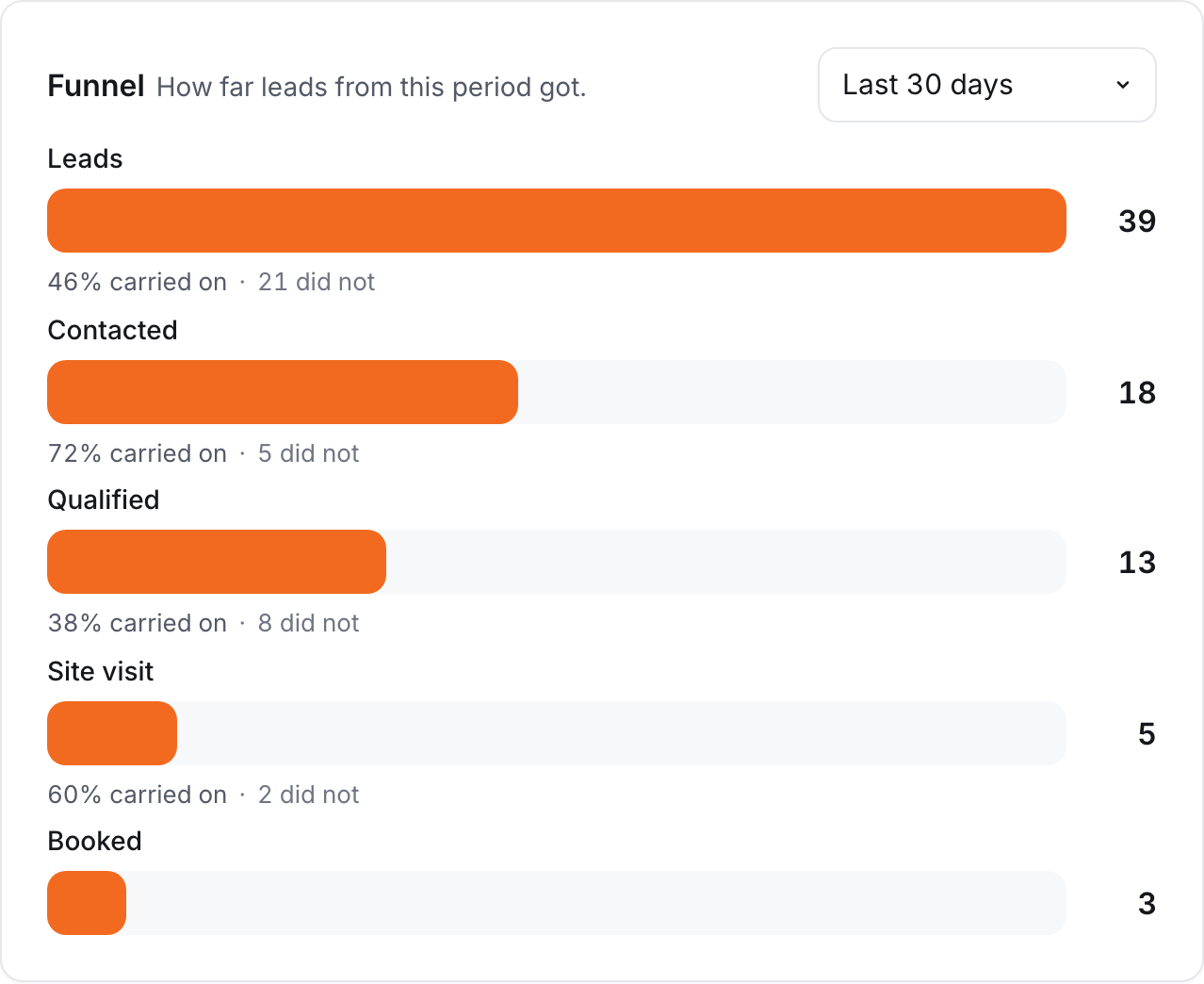
A portal webhook, an email, a form on your own site, and a spreadsheet. All four end in the same intake — so custom fields, attribution, routing and the response clock happen identically whichever way a buyer reached you. Adding a fifth portal is a mapping, not a project.
The inbox
Your whole team, one WhatsApp number.
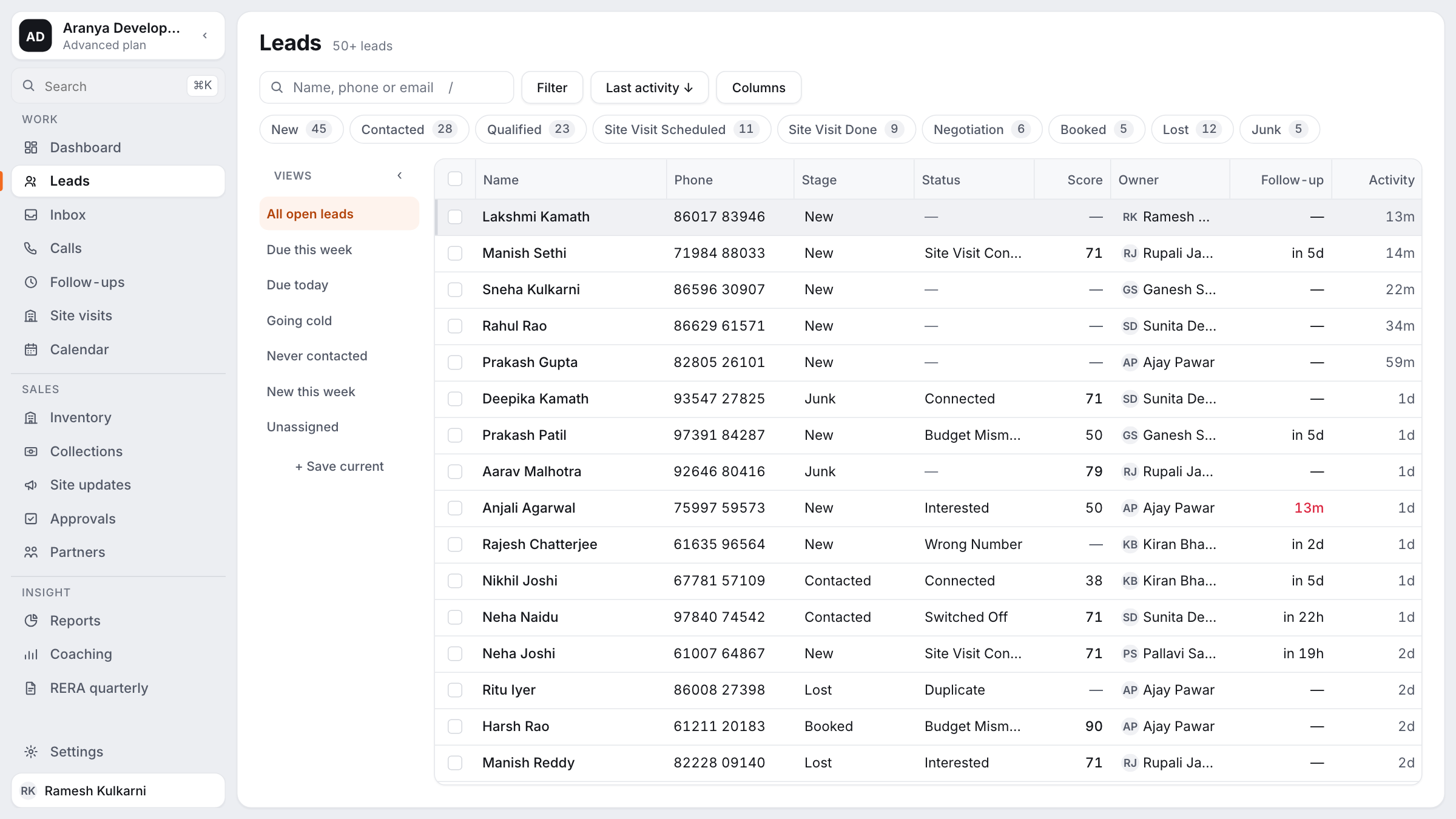
Conversations are assigned the way leads are. Everyone can see who is handling what, how long is left on the response target, and whether the thread can still take a free-form reply or needs an approved template — which is WhatsApp’s rule, not ours, and the one that silently loses messages when a product gets it wrong.
A conversation does not have to be a lead. Real inbound starts with “hi”, and turning one into a lead is a button rather than a prerequisite.
What the money did
Cost per booking, counted honestly.
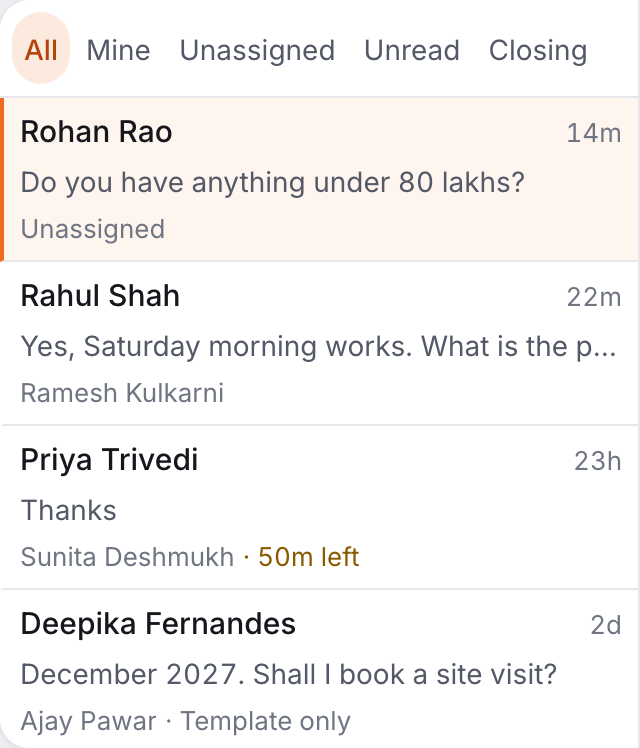
A booking is credited to the month the enquiry arrived, not the month it closed. In a market where a residential sale takes three to six months, the other way compares August’s bookings against August’s spend, which produced almost none of them — and the number then moves when you change your budget and when an old cohort happens to close, with no way to tell which.
The price of doing it properly is that a recent month is not finished yet, and the screen says so rather than showing you a number that is going to improve on its own.
The rest of it
What else is in there.
Calls
Click to call from the lead, recordings kept against the buyer, and a summary of what they asked and what was promised — every line carrying the words from the transcript it came from, so a manager can check it rather than trust it.
Site visits
Checked in from the gate on a phone, with the location, so a visit that happened is recorded as having happened — rather than depending on somebody typing it up that evening.
A field app
My leads, my follow-ups and the check-in, on Android and iOS. It keeps working in a basement: writes are queued and replayed, and a replay never duplicates anything.
Automation
Rules and sequences you configure rather than code. A buyer who replies stops receiving the nudges immediately, which is the one thing automation in this market most often gets wrong.
Channel partners
Registration with a real conflict check, an expiry, and a refusal that gives the date without naming the other firm. Commission accrues on the booking and withholding is recorded separately.
Reports
Six named reports, each labelled with the question it answers, exportable to CSV and Excel. Not a report builder — the commonest support ticket those produce is “why does my report not match the dashboard”.
Scope
This is pre-sales. It stops at the booking.
Inventory, cost sheets, demand letters, receipts, collections and accounting export exist and are available to builders who need them — but the product is bought for what happens before a booking, and that is what it should be judged on.
If what you actually need is a post-sales and accounts system, say so early and keep whatever you use for it. Leads can be pushed into it. You do not have to replace anything to try this.
See it on your own leads.
A walkthrough is about twenty minutes and ends with a lead you send in yourself, answered on your own phone. Write and say roughly how many enquiries you get a month and where they come from.